What a Live Table Camera Leaves Outside the Frame
See what a live table camera shows, what its framing hides, and how to separate a clear view of the action from evidence about an outcome.

A live table camera shows only the slice of a casino table selected by its lens and production layout. To read a live table camera well, follow what enters the frame, what an overlay covers, and what the image cannot establish about an outcome.
Where does the camera point?
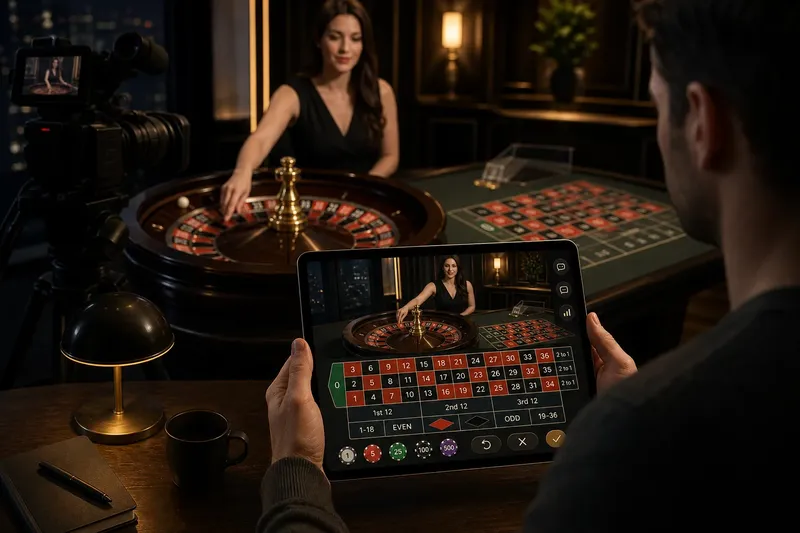
Start with the table itself. A wide view may show the dealer, several betting positions and the central playing area, while a closer view can make cards, chips or a wheel easier to see at the cost of surrounding context. The framing is a choice, not a neutral window onto the whole room.
Notice the edges of the image. A hand can enter from off-screen; a chip stack may sit partly behind a graphic; a card may be dealt near the boundary of a close shot. The camera can show a visible action without showing every movement that led to it.
Also look for changes between camera views. A cut from the dealer to a close-up can clarify a detail, but it may leave the moments before or after that detail outside the picture. Treat each view as one angle on the table, rather than as a continuous record of everything around it.
What does the table view make legible?
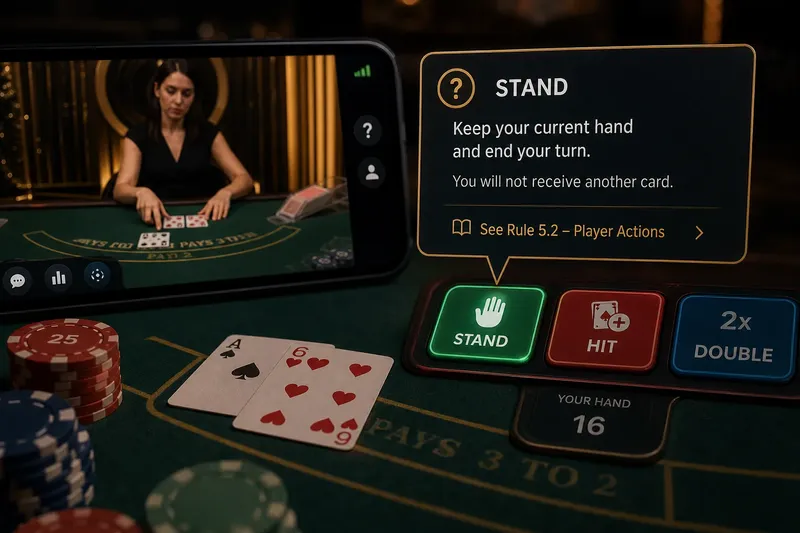
Separate the physical table from its digital presentation. Felt markings, printed betting areas and physical cards are part of the camera image; labels, prompts and animated indicators may be added by the interface. They can help orient a viewer, but they are not the same thing as the objects in the scene.
Consider how the camera handles depth and scale. A chip nearest the lens may look larger than one farther away, and a dealer’s hand can obscure a marked area while reaching across the felt. A straight-on view resembles reading a map through a window: useful for orientation, but not identical to standing over the table.
If the layout is unfamiliar, use the image to identify broad regions before interpreting small details. Ask whether you can distinguish the dealer’s working area, the players’ positions and the relevant playing surface. If a detail is too small or obscured, call it unclear rather than filling in the gap from expectation.
Which overlays cover or clarify the scene?
Overlays often carry information such as a round status, a timer, player selections or a prompt. Their placement matters. A box at the bottom of the screen may cover the near edge of the felt; a badge near a card can make it harder to see its border or suit.
Compare the same area before and after an overlay appears, if the interface allows it. Notice whether the graphic sits over the camera image, in a separate panel, or changes the crop of the video. A graphic can make a game state easier to read while still offering no additional view of the physical table.
Do not treat an overlay as an independent camera. It may report interface information rather than depict a physical object, and its presence does not reveal what lies beyond the video frame. Keep those two sources distinct in your reading.
How should you read a close-up or camera cut?
When a detail becomes important, check whether the close-up actually resolves it. A tighter crop can enlarge a card or betting area, but it can also exclude the dealer’s hands, neighbouring positions or the wider table. Ask what the crop adds and what it removes at the same time.
Imagine a viewer sees a close shot of a card, then a graphic identifying the round. The card’s visible face may be clear, while the close shot leaves the dealer’s other hand outside the frame; the graphic may identify a state without filling that visual gap. The sensible observation is that the face is visible in the image, not that every relevant action has therefore been shown.
Watch for transitions rather than assuming a cut is a continuous view. A brief change in framing can mean that the production is prioritising a particular detail. It does not, by itself, tell you why the camera changed or establish anything about the result.
What can a live table camera establish?
Can a camera show every part of the table?
No single frame necessarily includes the full playing surface, the dealer’s hands and every player position. Even a broad shot has edges, blind spots and moments when objects overlap.
Does a clear card image prove how it was dealt?
It can show the card as presented in that image, but the image alone may not show the complete sequence of handling. Distinguish the visible detail from any wider claim about events outside the frame.
Are interface graphics part of the camera feed?
Not necessarily. Some are interface elements layered over video, while others may be part of the displayed scene; their appearance and function depend on the particular service.
Can framing tell you why an outcome occurred?
Framing describes what the production chooses to show, not the cause of an outcome. A camera view can support a limited observation, but it cannot make an unseen event visible simply by presenting a result graphic.
What is the careful way to describe what you saw?
Use language that matches the image. “The card is visible in the close-up” is narrower and more accurate than “the camera showed the whole deal”. If a hand, object or transition is obscured, say that the relevant moment is not clear in the view.
For a quick reading, check:
- Angle: Is the view wide, overhead or close, and which parts of the table fall beyond its edges?
- Occlusion: Does a hand, chip stack or graphic cover the area you are trying to see?
- Scale: Is the detail legible, or does perspective make its position uncertain?
- Overlay: Is the information part of the table image or a separate interface label?
- Transition: Did the camera cut away before or after the action you are assessing?
- Claim: Does your description state only what is visible, or infer an unseen cause?
These distinctions make a live table camera easier to read without asking it to do more than show its frame. The useful habit is simple: describe the visible object, name any obstruction, and keep conclusions about outcomes separate from the limits of the image.